
RegTech AML: Building Smarter Financial Crime Controls
AML Regtech
Financial crime compliance is becoming harder to manage with traditional systems alone. Banks and fintechs deal with growing transaction volumes, changing sanctions, new payment channels, and risk information coming from thousands of sources. This is where regtech aml is becoming increasingly relevant. Modern compliance technology can connect screening, monitoring, risk intelligence, and automation within a single operational environment. The value is not simply replacing manual work with software. It is helping compliance teams make better decisions while keeping the process scalable.
Why RegTech AML Matters to Financial Institutions
Compliance teams may have to be multi-system in order to investigate a single customer or transaction. Adverse media is screened in one platform, and adverse media and internal records are tracked in another. This creates gaps; It can also cause investigations to be slower when investigators have to gather context manually. FATF considers RegTech a means that technology can be used to assist regulated entities in their AML/CFT obligations in a more efficient manner. Its recent work also points to the application of AI, machine learning, big data, and advanced analytics that could be applied to customer due diligence and monitoring. The real challenge for financial institutions is to implement these features into their daily operations without introducing an additional system that is not integrated.
How RegTech AML Solutions Are Changing Compliance Operations
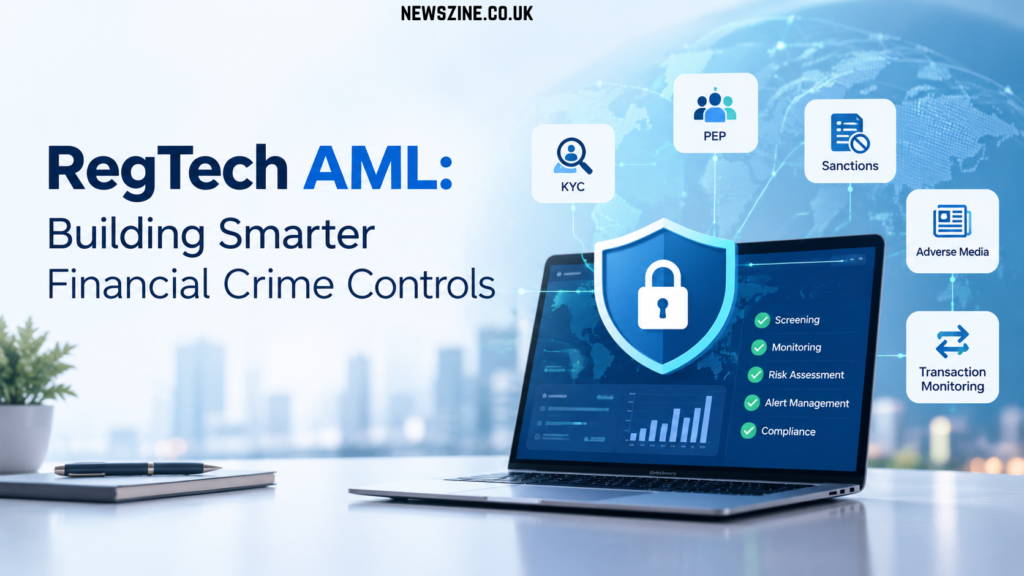
Modern AML Regtech solutions are transcending the list screening model. They can link customers to sanctions, PEPs, adverse media, watchlists, and transaction behaviour. This becomes important if there is not an obvious place for the risk. It is possible that the customer has no sanctions match but has relevant adverse media. A transaction could appear to be normal on its own but unusual if compared to its historical behaviour. A connected AML environment allows analysts to provide more context before determining if an alert is worth investigating. AML Watcher does just that, with a platform that includes screening, continuous monitoring, transaction monitoring, and AI power. It comes with its proprietary data layer, which includes 235+ countries and states, 3,500+ watchlists and over 100,000 sources. These capabilities are synced with each other to minimise the need to switch between different tools for institutions that manage high volumes of compliance data.
Where AI-Driven RegTech Solutions Add Value
Compliance teams handle vast quantities of data, making AI-powered RegTech solutions a game-changer. AI can be utilised to identify patterns, prioritise alerts, and integrate relevant information into a risk decision. Automation only adds value when the data and decision process are reliable. The compliance challenge is not a fast enough system that delivers more irrelevant alerts. AML Watcher applies AI via its TruRisk technology to assist L2 screening decisions. According to the company, TruRisk can cut down the false alarm queue by up to 80% and log its decisions for explainability. Its transaction monitoring capabilities also include 150+ expert-curated AML typologies and 10,000+ customizable risk rules. This is beneficial for financial institutions that require automation without sacrificing human oversight and involvement in critical risk decisions.
What AML RegTech Companies Need to Deliver at Scale
There are numerous AML RegTech firms in the market today, but financial institutions do not just need another compliance interface. When selecting technology, it is important to consider data coverage, data integration, monitoring, explainability, and adaptability. A solution should align with current workflows, not require compliance teams to reshape their workflows to fit the solution. Integration is particularly important for banks and fintechs. AML Watcher can be integrated with a REST API and is available for in-country, on-premises, and cloud deployment. It has a published implementation time of 2 to 4 hours based on the current environment. Such flexibility can be useful to businesses that are regulated in various markets. Requirements for compliance might differ, but the requirement for reliable risk intelligence does not. The best AML technology is not always the one with the greatest number of features. It is the one that can accommodate the institution’s risk environment and stay current with changing risk environments.
Connecting AML RegTech With the Future of Compliance
Financial crime does not stay within one data source or one compliance function. Risks can emerge through customer relationships, transactions, sanctions, public information, or changes in a customer’s profile. That makes disconnected compliance processes harder to sustain. AML RegTech can bring these signals closer together. Instead of treating screening and monitoring as separate activities, financial institutions can create a more connected process where data, automation, and analyst judgment work together. AML Watcher is built around this model. Its platform combines proprietary AML intelligence with screening, ongoing monitoring, transaction monitoring, and AI-powered risk analysis. The company says its technology supports more than 95% automation across AML processes. For banks, fintechs, payment providers, and other regulated businesses, the goal is not simply to adopt newer compliance technology. It is to create an AML operation that can identify relevant risk faster, reduce unnecessary manual work, and remain responsive as financial crime patterns change. Explore AML Watcher to bring screening, monitoring, proprietary AML data, and AI-powered risk intelligence into one connected compliance environment.