Carbon Accounting: How Carbonxgen Turns Emissions Data into Valuable Business Insights
Carbonxgen
As companies endeavour to minimize environmental footprint, optimize their operations, and address sustainability demands, Carbon Accounting has emerged as a key business practice. By leveraging Carbonxgen for accurate data gathering, structured analysis and actionable sustainability strategies, businesses can gain a clear understanding of their GHG emissions. Carbonxgen integrates environmental knowledge with cutting-edge technology to convert complex emissions data into actionable insights and guidance for making informed decisions. Since the organisations can either look at saving energy, improving regulatory compliance or set up measurable targets for carbon reduction, Carbonxgen can offer solutions that make the environmental responsibility and long term business performance link.
Topics covered include an understanding of Carbon Accounting and its significance for businesses today.Students will learn about the significance of Carbon Accounting and its importance to businesses in modern times.
Carbon Accounting is the measurement, calculation, monitoring and reporting of GHG emissions resulting from business operations. It can assist organisations in setting up their carbon footprint and identify their contribution to climate change.
Businesses generate emissions from their buildings, manufacturing processes, supply chains, transportation, fuel use and electricity use. If reliable measurements are not available, it can be difficult to identify emission sources and prioritise opportunities for emission reductions.
A GHG structured inventory enables companies to track environmental performance over time, benchmark operational activities and set achievable GHG reduction targets.
Understanding the three categories of greenhouse gas emissions: Scope 1, Scope 2 and Scope 3.
The GHG Protocol categorises an organisation’s greenhouse gas emissions into three distinct reporting scopes.
Scope 1 contains any direct emissions from the sources that are owned or controlled by an organization, such as company vehicles and fuel burning equipment.
The scope 2 emissions refer to the indirect emissions resulting from the use of purchased electricity and heat, steam and cooling.
Other indirect emissions related to other value chain areas (purchased goods, transportation, business travel, waste disposal) are part of Scope 3.
Having knowledge of these categories enables businesses to identify major emission sources and work on effective measures to reduce emissions.
How Carbonxgen “solve” the challenges of emissions data into business intelligence
Gathering environmental data is just the first step towards an effective emissions management system. The true power comes when businesses convert that information into actionable insights that feed into their operations.
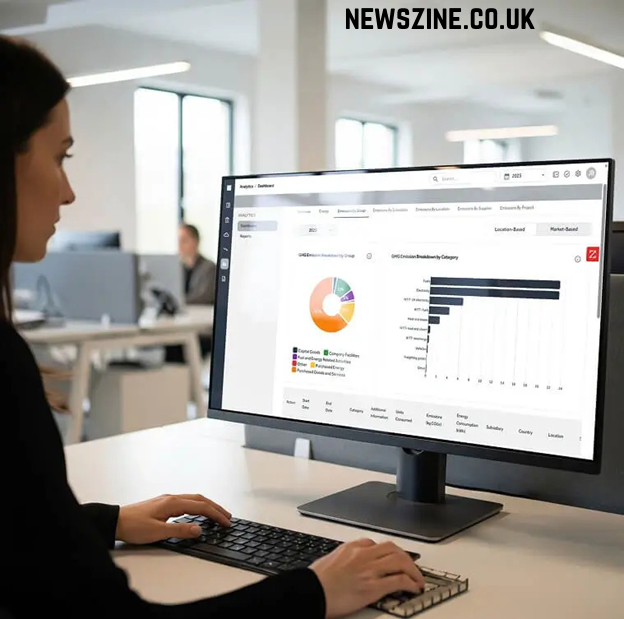
Carbonxgen is working on this transformation with its Carbon Accounting platform and CarbonXcelerate technology that weaves emissions reporting into energy management, energy procurement and energy improvements.
The centralised EC process is one in which the various advertising and promotions are gathered in a single location.
Information about business emissions is often dispersed in energy meters, utilities bills, building management systems and operational records.
Carbonxgen supports the process of building a coherent space to share the relevant information – this helps to make environmental performance more digestible, both at the level of individual buildings and in larger commercial property portfolios.
Centralisation enhances visibility, minimises multiple reporting, and creates a better basis for emissions calculations.
Advanced Analysis and Performance Monitoring
When data is organized, it allows businesses to track energy consumption, detect any anomalies, and assess business performance.
Carbonxgen brings together energy and carbon information and makes it useful to making management decisions, enabling organisations to discover efficiency and emissions reduction opportunities.
Structured reporting also enables comparisons of buildings, operating periods and sustainability goals.
Transforming CO2 data into business value
Beyond environmental reporting, Effective Carbon Accounting has benefits. A combination of reliable measurements and business intelligence can enable organisations to make better financial and operational decisions.
Recognizing EE Opportunities
Energy use can be a substantial cost of operation.
Electricity, gas and heating data analysis can identify inefficient equipment, unnecessary energy consumption and operational improvements.
This data can be leveraged by businesses to focus on energy efficiency initiatives, estimate potential savings, and minimize unnecessary energy use.
Financial Planning and Resource Allocation – Improvement
Having accurate emissions information aids in making more informed investment choices.
Organisations can be compared with proposed sustainability initiatives considering implementation cost, estimated emissions reduction, operational saving and long term business benefit.
This can enable the management teams to plan resources strategically rather than just for compliance activities.
Improving the performance of corporate sustainability
By providing accurate environmental reporting, there is increased transparency to investors, customers, employees and commercial partners.
It also helps to achieve measurable sustainability goals and demonstrates progress towards the company’s commitment to decarbonisation.
Ensuring regulatory compliance and environmental reporting
The management of sustainability information still remains heavily affected by environmental reporting obligations.
Depending on the businesses and the relevant regulations, businesses may have to take into account the Greenhouse Gas Protocol, Streamlined Energy and Carbon Reporting (SECR) and the IFRS S2 climate-related disclosure requirements.
Establishing Reporting Records that will be Reliable and Auditable
Carbon Accounting helps to make the emissions disclosures more consistent by providing documented calculation methods, suitable emission factors and clear reporting boundaries.
Structured reporting is facilitated through controlled data management and documented emissions calculations with Carbonxgen, which enables organisations to gather more accurate data for compliance checks and stakeholder reporting.
Carbonxgen+1
Having clean records also helps in tracing back discrepancies in the data and shows reporting methods.
Emissions Insights are a key component of developing long-term strategies to reach Net Zero.Emissions Insights are an important part of building a long-term Net Zero Strategy.
Establishing a credible net zero pathway needs to know where they are in relation to the environment.
First, businesses need to find out the sources of their big emissions, get some baseline data, set an attainable target, and track the development over time.
Setting up Carbon Reduction Targets
Establishing clear emissions reduction goals requires a comprehensive assessment of an organisation’s greenhouse gas output.
Organisations can focus on energy efficiency in buildings, buying renewable electricity, operational changes, and supplier engagement.
Assessments for tracking progress and continuous improvement
By linking emissions measurement to broader sustainability planning, Carbonxgen allows organisations to assess performance and find other areas of potential improvement.
By regularly monitoring, businesses can check if initiatives are going according to plan and if there is a need for further action.
The following are some of the common challenges in carbon emissions management:
The most common problems businesses face are incomplete records, inconsistent format of data, complex supply chain, and lack of internal resources.
Specific issues may arise when dealing with Scope 3 emissions as information may rely on suppliers and other external organisations.
By enhancing data governance, documenting assumptions, using recognised calculation methods and regularly checking information, the reporting accuracy can be enhanced.
General Q&A on Carbon Accounting
Understanding Carbon Accounting: Its Purpose, Process, and Business Significance
It involves quantifying and documenting the greenhouse gases generated through an organisation’s operational activities. It allows organisations to gain insight into their environmental footprint, locations where environmental impacts can be reduced and assist them in sustainability reporting.
How can emissions help to enhance business performance?
Emission data can be used to uncover wasteful energy use, facilitate cost-saving strategies, optimize resource allocation, and enable management to assess environmental investments.
The information that would be needed to compute the carbon footprint of a company is as follows:
Electricity and fuel consumption records, information on the business’s operational activity, transportation data, and supply chain information are typically required for businesses. There are organisational boundary and emissions categories dependent requirements.
How does carbon reporting aid in regulatory compliance?
The structured emissions reporting enables organisations to build up an environmental disclosure that is consistent and maintain supporting documents and meets applicable sustainability reporting requirements.
5. When does a business need to update their emissions data?
Businesses should keep an eye on the pertinent information regularly and make inventories based on their reporting requirements. Frequent monitoring can aid in finding inefficiency in the operation and track reduction programmes.
Conclusion
Precise emissions measurement is now more important than ever for businesses looking to boost their environmental performance and operational efficiency.
Carbon Accounting merges dependable data, reporting capabilities, and real-world sustainability know-how, transforming it from a compliance task into a meaningful, practical endeavor. It gives you a starting point for making informed investment decisions, quantifying emissions reductions and effective long term planning.
Companies that leverage environmental data for informed decision-making can enhance financial stability, transparency, and sustainability.