
Quentin Tarantino and Matthew McConaughey: Two Distinct Careers That Never Fully Crossed on Screen
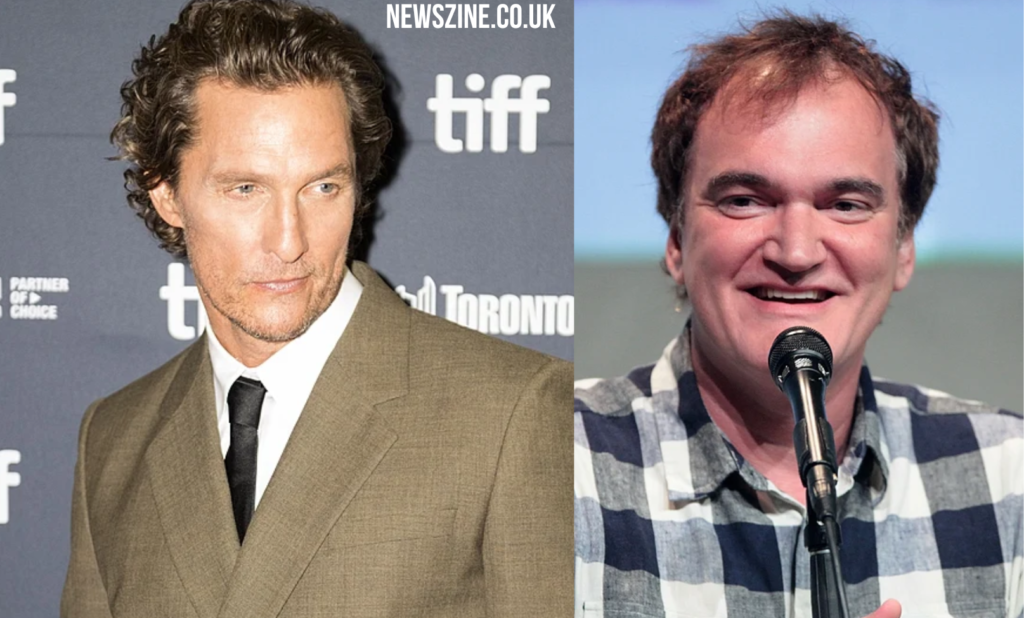
Quentin Tarantino and Matthew McConaughey
Quentin Tarantino and Matthew McConaughey are two major figures in American cinema, but their careers developed along very different paths. Tarantino became known primarily as a writer and director whose films are closely associated with dialogue, crime stories, genre references, unconventional storytelling, and carefully selected casts. McConaughey built his reputation in front of the camera, moving between comedy, drama, thrillers, science fiction, and character-driven projects.
Because both men have spent decades working in Hollywood and have strong connections to crime films, Western-influenced stories, and unconventional characters, it is easy to assume their careers must have crossed on a major production. Yet McConaughey has not become part of Tarantino’s familiar group of actors, and the two are better understood through their separate bodies of work rather than through a significant film partnership.
Their careers still make an interesting comparison. Both have taken risks, resisted being permanently defined by one type of work, and reached some of their most important professional milestones after making choices that went against expectations.
Quentin Tarantino Built His Career Around Writing and Directing
Quentin Tarantino emerged as a major filmmaker during the independent cinema movement of the early 1990s. Rather than following a conventional route through large studio productions, he attracted attention through screenwriting and low-budget filmmaking.
Reservoir Dogs, released in 1992, established many characteristics that audiences would later associate with his work. The story centered on criminals dealing with the aftermath of a failed robbery, but much of its impact came from conversations, conflicting accounts, shifting loyalties, and tension between characters.
Two years later, Pulp Fiction dramatically expanded Tarantino’s profile. Released in 1994, the film brought together several interconnected stories involving criminals and other figures in Los Angeles. Its structure did not follow a simple chronological order, while its dialogue and mixture of violence, humor, and everyday conversation helped distinguish it from conventional crime films.
The success of Pulp Fiction established Tarantino as a filmmaker whose name itself could become part of a movie’s identity. Instead of moving quickly from project to project, he generally developed films at his own pace and maintained substantial creative control over his work.
Tarantino’s Films Became Closely Connected to Their Actors
Casting has always been an important element of Tarantino’s filmmaking. Some performers have worked with him repeatedly, while others have received roles that introduced audiences to a different side of their abilities.
Samuel L. Jackson became one of the actors most closely connected with Tarantino’s work through films including Pulp Fiction, Jackie Brown, Django Unchained, and The Hateful Eight. Uma Thurman became central to Pulp Fiction and the two Kill Bill films. Christoph Waltz received major attention through Inglourious Basterds and later appeared in Django Unchained.
Tarantino has also cast established stars such as Leonardo DiCaprio, Brad Pitt, Jamie Foxx, Kurt Russell, Robert De Niro, and Margot Robbie.
Matthew McConaughey, however, has not developed this kind of working relationship with Tarantino. That distinction matters because discussions connecting the two can sometimes create the impression that McConaughey belongs to Tarantino’s filmography. His major acting achievements came through collaborations with other directors.
Matthew McConaughey Entered Hollywood Through a Different Route
Matthew McConaughey was born on November 4, 1969, in Uvalde, Texas. His route toward acting developed during his university years rather than through a long childhood connection to the entertainment industry.
He studied Radio-Television-Film at the University of Texas at Austin and graduated in 1993. Around the same period, an opportunity arrived that became an important starting point for his screen career.
McConaughey appeared as David Wooderson in Richard Linklater’s Dazed and Confused. Although the role was not the film’s central part, his performance attracted attention. Wooderson had a relaxed manner and memorable presence that made the character stand out within the ensemble.
The film did not immediately turn McConaughey into a conventional leading man, but it gave him valuable exposure and opened the way to more substantial acting opportunities.
A Time to Kill Changed McConaughey’s Position in Hollywood
One of the defining early moments of McConaughey’s career arrived with A Time to Kill in 1996. He played lawyer Jake Brigance in the film adaptation of John Grisham’s novel.
The part demanded something different from the casual screen personality associated with his earlier work. McConaughey was required to carry a serious courtroom drama and hold his own within a cast that included Samuel L. Jackson, Sandra Bullock, and Kevin Spacey.
Its success helped establish him as a leading actor. During the years that followed, he moved through several genres instead of remaining tied exclusively to courtroom stories.
He appeared in Contact, Amistad, EDtv and U-571, among other projects. His early filmography therefore developed through a mixture of mainstream dramas, large productions, and character-based films.
Romantic Comedies Became a Major Part of McConaughey’s Image
During the 2000s, McConaughey’s career moved heavily toward romantic comedy. Films such as The Wedding Planner, How to Lose a Guy in 10 Days, Failure to Launch, Fool’s Gold, and Ghosts of Girlfriends Past placed him within a commercially familiar type of role.
These movies strengthened his status as a recognizable Hollywood leading man. At the same time, repeated appearances in similar productions gradually narrowed the way audiences and filmmakers viewed him.
McConaughey eventually began moving away from that cycle. Rather than continuing to accept projects that relied on the same screen persona, he became more selective about the roles he wanted to pursue.
That decision led to one of the most significant changes of his career.
McConaughey’s Dramatic Reinvention
The shift became visible with The Lincoln Lawyer in 2011. Playing defense attorney Mick Haller allowed McConaughey to return to a darker dramatic setting while retaining the confidence and conversational ease that had long been part of his screen presence.
A series of very different performances followed.
He appeared in Killer Joe, Magic Mike, Mud, and The Paperboy. These projects gave him opportunities to play characters who were morally complicated, unpredictable, damaged, or far removed from the romantic leads that had dominated his previous decade.
This period became widely associated with a major reassessment of McConaughey as an actor. Instead of simply changing genres, he demonstrated that he could carry smaller dramas and supporting parts without depending on his established leading-man image.
Dallas Buyers Club Became a Career Milestone
McConaughey’s performance in Dallas Buyers Club marked one of the most important points in his professional life. Released in 2013, the film cast him as Ron Woodroof, a Texas man diagnosed with AIDS during the 1980s.
The role demanded a substantial physical and dramatic transformation. More importantly, McConaughey approached Woodroof as a complicated person rather than reducing him to a straightforward heroic figure.
His work in the film earned him the Academy Award for Best Actor.
Around the same period, he appeared briefly in Martin Scorsese’s The Wolf of Wall Street. Despite limited screen time, his performance as Mark Hanna became one of the movie’s recognizable sequences.
The combination of these roles confirmed how far McConaughey’s career had moved from the romantic-comedy period.
True Detective and Interstellar Expanded His Range Further
McConaughey’s work as Rust Cohle in the first season of True Detective provided another important showcase for his dramatic abilities. The character was a Louisiana detective whose philosophical outlook, investigative methods, and troubled history shaped much of the series.
The television format gave McConaughey more time to develop the character than a typical feature film could provide. His scenes with Woody Harrelson depended heavily on long conversations, conflicting personalities, and gradual revelations.
Soon afterward, McConaughey starred in Christopher Nolan’s Interstellar. As Cooper, he played a former pilot who leaves Earth as part of a mission seeking a future for humanity.
The scale of Interstellar was very different from the intimate crime story of True Detective, yet both projects relied on McConaughey’s ability to balance emotional material with complicated narratives.
Why McConaughey Seems Suited to a Tarantino Film
The idea of Matthew McConaughey appearing in a Quentin Tarantino movie feels believable because several elements of his acting style could fit Tarantino’s approach to character.
McConaughey has a distinctive speaking rhythm. He can make long stretches of dialogue feel conversational rather than simply recited. Tarantino frequently builds scenes around extended conversations in which the meaning of the exchange changes as information is slowly revealed.
McConaughey has also shown that he can play charming characters without making them completely trustworthy. His performances in films such as Killer Joe and The Gentlemen demonstrate an ability to shift between humor, confidence, menace, and unpredictability.
Those qualities overlap with the kinds of characters that often appear in Tarantino’s films. However, compatibility in style does not mean that a collaboration has actually formed.
Their Connections to Western and Southern American Storytelling
Another reason Quentin Tarantino and Matthew McConaughey can appear naturally connected is their separate interest in stories influenced by the American South and West.
Tarantino explored Western conventions directly in Django Unchained and The Hateful Eight. Even some of his films that are not traditional Westerns borrow ideas from the genre, including confrontations between isolated characters, revenge narratives, shifting alliances, and violent standoffs.
McConaughey’s Texas background has influenced his public identity and some of his screen roles. Films such as Lone Star, Mud, Dallas Buyers Club, and Killer Joe place him in stories where regional identity contributes strongly to the characters and atmosphere.
The two men therefore approach some similar cultural territory from opposite sides of filmmaking. Tarantino constructs the setting and narrative as writer-director, while McConaughey uses voice, physical behavior, and characterization to inhabit a story created by someone else.
Both Careers Depend Heavily on Dialogue
One of the clearest similarities between their work involves dialogue.
Tarantino often allows conversations to occupy a large portion of a scene before the plot moves forward. A discussion may initially appear unrelated to the central conflict, only to reveal information about power, fear, deception, or the intentions of the people involved.
McConaughey is particularly comfortable with dialogue-driven characters. Rust Cohle in True Detective is an obvious example, but the same quality appears throughout his career. His delivery can move between slow reflection, humor, persuasion, anger, and sudden intensity.
This does not make him a “Tarantino actor,” but it explains why viewers can easily imagine him handling the director’s lengthy exchanges.
Tarantino’s Recognition as a Screenwriter
Although Tarantino is widely discussed as a director, screenwriting has been central to his career. His major awards reflect that importance.
He received the Academy Award for Best Original Screenplay for Pulp Fiction and later won the same award for Django Unchained. His films have also received recognition from organizations including BAFTA and the Golden Globes.
Pulp Fiction won the Palme d’Or at the Cannes Film Festival, helping establish Tarantino internationally during the early part of his career.
Later films including Inglourious Basterds and Once Upon a Time in Hollywood continued to receive major awards attention. His career has therefore remained closely tied to his ability to create characters through written conversations as much as through visual direction.
McConaughey’s Career Has Been Defined by Adaptation
McConaughey’s professional history presents a different type of achievement. His longevity has depended on his willingness to change the kind of work he accepts.
He began with supporting characters, moved into leading dramatic roles, became closely identified with romantic comedies, stepped away from that pattern, and then rebuilt his career around more demanding dramatic projects.
Few actors maintain the same position in Hollywood without adjusting over time. McConaughey’s career demonstrates how a performer can deliberately move away from an established commercial identity without abandoning the characteristics that originally made audiences recognize him.
His Texas accent, relaxed delivery, humor, and physical confidence remained present, but he learned to use those qualities differently depending on the character.
Two Careers That Developed Without Needing a Collaboration
A Quentin Tarantino and Matthew McConaughey film would naturally attract attention because both have recognizable creative identities. Yet their careers are notable precisely because each built a substantial body of work without depending on the other.
Tarantino created films in which the writer-director’s voice is often as recognizable as the actors appearing on screen. McConaughey developed as a performer capable of moving between filmmakers with very different methods, including Richard Linklater, Steven Spielberg, Christopher Nolan, Martin Scorsese, William Friedkin, Steven Soderbergh, and Guy Ritchie.
Their paths represent two different forms of career control. Tarantino largely controls the worlds he creates from behind the camera. McConaughey exercises control through the projects and characters he chooses to perform.
Quentin Tarantino and Matthew McConaughey Remain an Interesting Hollywood Pairing
Quentin Tarantino and Matthew McConaughey do not need an established film partnership to make a comparison between them worthwhile. Their careers show two distinct ways of creating a recognizable identity within American cinema.
Tarantino built his reputation through original screenplays, carefully constructed dialogue, genre experimentation, and films shaped around his own directorial perspective. McConaughey built his through performance, first establishing himself as a leading man and later deliberately expanding the kinds of characters he was willing to play.
Their careers have touched similar genres and themes without fully intersecting. Crime stories, Southern settings, Western influences, unusual characters, and dialogue-heavy scenes appear across their work, but each approaches those elements from a different professional position.
For that reason, the connection between Quentin Tarantino and Matthew McConaughey is less about a famous collaboration and more about two long Hollywood careers that developed alongside one another while following separate creative routes.