
Research Dossier for Target Company: Building a Clear Picture Before a Business Decision
Research Dossier for Target Company
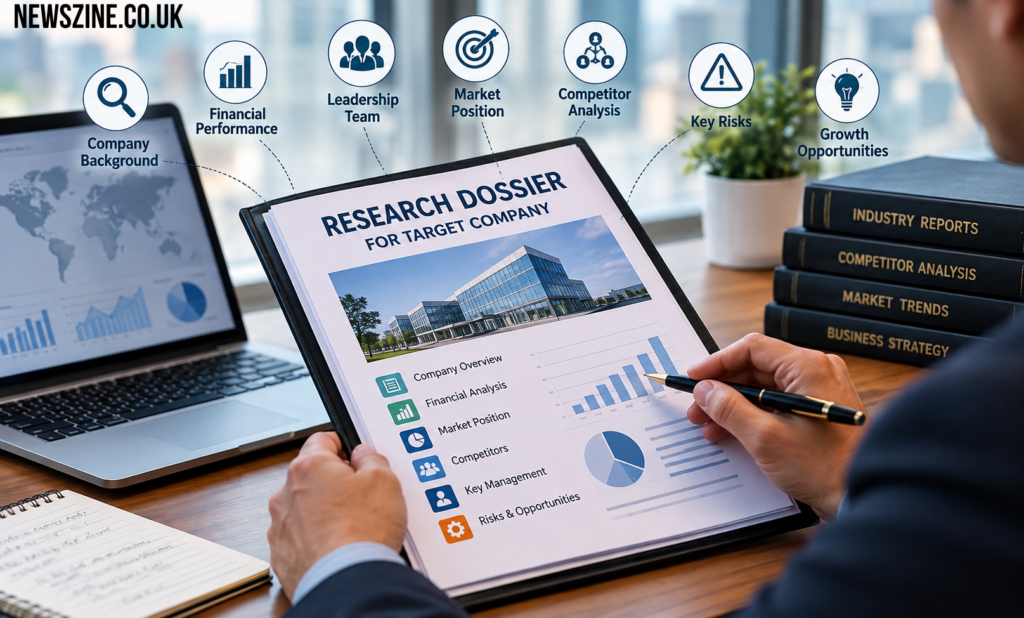
A research dossier for target company evaluation is prepared when a business needs more than a quick overview of another organization. It brings important details into one place so that the people involved can understand who the target is, how it operates, where its income may come from, who manages it, and what issues could affect a future relationship. Such research can support acquisition planning, investment reviews, partnerships, competitive analysis, or business development.
The usefulness of a dossier depends less on its length and more on the quality of its information. Copying company descriptions, collecting random statistics, or filling pages with general industry material does not provide much practical value. The document should instead answer specific questions about the target and show which findings are confirmed, which require further checking, and which could influence the final decision.
Why a Target Company Needs Detailed Research
Businesses rarely make major decisions based on a company’s website or a few financial numbers. A target may appear successful from the outside while depending on one major customer, facing strong competition, carrying substantial debt, or operating in a market that is becoming difficult. Another company may look relatively small but possess valuable technology, specialist employees, long-standing customer relationships, or access to an attractive market.
Detailed research helps uncover this wider picture before a company commits substantial resources. It can also reveal areas that deserve closer investigation later. The dossier is not necessarily a replacement for formal due diligence. Instead, it can provide an informed starting point and help a team determine whether deeper investigation is justified.
Establish the Exact Purpose Before Collecting Information
The first question should be simple: why is this company being researched? The answer determines what belongs in the dossier. An acquisition team, for example, may be interested in ownership, profitability, liabilities, assets, customers, management, and potential integration problems. A company considering a partnership may place greater importance on reputation, capabilities, geographical coverage, and existing commercial relationships.
Defining the purpose also prevents research from becoming unnecessarily broad. Information can be interesting without being useful. A focused researcher continuously asks whether a particular fact could influence the decision under consideration. If it cannot, it probably deserves less space in the final document.
Establishing the Company’s Real Identity
A reliable dossier begins by confirming exactly which business is under review. The trading name seen by customers may differ from the registered company name, while a familiar brand may actually belong to a larger corporate group. Subsidiaries, parent companies, joint ventures, and previous business names can make identification more complicated.
This section can establish where the company operates, when it was formed, what it sells, which markets it serves, and how its corporate structure is arranged. Getting these basic facts right is important because an error at this stage can affect later research. Financial records or legal information belonging to a similarly named company, for example, could lead to completely incorrect conclusions.
Following the Money Through the Business
Understanding the target’s revenue model provides a clearer view of how the organization functions. Researchers should look beyond the general description of its products and ask who actually pays the company, what customers pay for, whether payments are recurring, and how predictable that income might be.
A software provider receiving monthly subscription fees has a different commercial structure from a construction contractor working on individual projects. Likewise, a manufacturer supplying several hundred customers may carry a different level of concentration risk from one relying on two major buyers. Looking at the mechanics behind revenue can reveal details that headline sales figures alone cannot show.
Examining What the Company Actually Sells
Product and service research should explain the target’s commercial offering in practical terms. This means identifying its important products, services, customer groups, and delivery methods without simply repeating promotional language from company materials.
It can also be useful to look at how the offering has changed. New services may indicate expansion into another customer segment, while discontinued products can show where the company has reduced its attention. Changes in pricing, distribution, packaging, or service delivery may provide additional clues about how the business is adapting.
Looking Behind the Ownership Structure
Ownership affects more than the names listed on corporate records. It can influence financing, management priorities, decision-making authority, and the likelihood of a transaction. Founder-controlled companies, private-equity-backed businesses, listed corporations, and subsidiaries of larger groups can each have very different objectives.
Researchers should therefore establish who ultimately controls the target whenever dependable information is available. Related companies should also be examined when they have an important connection to operations. This can help clarify whether assets, employees, intellectual property, property, or contracts sit within the target itself or elsewhere in its wider corporate structure.
Studying the People Running the Company
Leadership research provides context that financial statements cannot always offer. Founders, chief executives, finance leaders, board members, and senior operational managers may all influence the direction of the organization. Their professional histories can help explain how the present management team was formed and what experience it brings.
Recent appointments and departures can be particularly important. Several leadership changes within a short period may deserve further investigation, although they should not automatically be interpreted negatively. The dossier should record what is known and explain why a change could be relevant without inventing motives that cannot be verified.
Reading Financial Information With Context
Financial figures are valuable only when they are interpreted carefully. Revenue growth can look positive while margins are falling. Profit can increase while cash generation weakens. Debt may be manageable for a stable business but more concerning for a company facing unpredictable demand.
The financial section should therefore examine relationships between available figures rather than treating each number separately. Revenue direction, profitability, debt, cash position, investment requirements, funding history, and major changes between reporting periods can all contribute to the analysis. When information is limited because the target is privately held, that limitation should be stated clearly rather than filled with unsupported estimates.
Understanding Where the Target Fits in Its Market
A business should be evaluated in relation to the environment around it. The dossier should consider who buys from the company, what problems its products solve, how demand is changing, and what alternatives customers have.
Market position is not always determined by size. Some smaller businesses survive because they serve a specialist customer group that larger competitors overlook. Others compete through pricing, technical expertise, convenience, distribution, customer relationships, or geographical coverage. Identifying the actual basis of competition provides a more useful picture than simply describing the overall industry.
Identifying the Competitors That Really Matter
A competitor list becomes useful only when it explains why certain companies compete with the target. Two businesses may operate in the same broad industry without regularly competing for the same customers. Researchers should therefore focus on organizations offering similar solutions to similar buyers.
The comparison can examine areas such as pricing, product breadth, customer type, distribution, location, technology, and service model. The purpose of the comparison is not to decide which company comes out on top. It is to understand where the target has advantages, where alternatives appear stronger, and how difficult it may be for customers to switch between providers.
Checking the Strength of Customer Relationships
Customers can reveal a great deal about the health of a company. Long-standing contracts and repeat purchasing may contribute to stability, while dependence on a small number of accounts can expose the business to significant disruption if one customer leaves.
Public information will not always reveal individual customer values, especially for private companies. Researchers should work with what can reasonably be confirmed through contract announcements, case studies, filings, customer references, or other credible material. Unknown information should remain unknown rather than being converted into assumptions.
Finding Dependencies Hidden Inside Operations
Not every business risk appears on the customer side. A company may depend heavily on a particular supplier, production facility, technology provider, distributor, specialist employee, or logistics network. Losing access to any one of these could affect its ability to continue normal operations.
The dossier should therefore look for operational concentration as well as commercial concentration. If a manufacturer relies on a difficult-to-replace component, for example, its supply chain deserves attention. A digital business could face a similar issue if an essential part of its service depends entirely on one external platform.
Reviewing Technology and Business Know-How
For some targets, much of the company’s value may exist in systems, processes, software, designs, patents, trademarks, data, or specialist knowledge. These assets deserve attention when they contribute directly to the company’s ability to compete.
The important question is not simply whether intellectual property exists. Researchers should consider how it connects with the commercial operation. Technology that lowers operating costs, protects an important product, improves customer retention, or makes replication difficult may have genuine strategic significance. Technology that is expensive to maintain but provides little differentiation may present a different picture.
Checking Legal and Regulatory Exposure
A company’s legal position can influence a potential transaction or commercial relationship. Depending on the sector, research may cover litigation, licenses, regulatory investigations, intellectual property disputes, environmental requirements, employment matters, or other compliance obligations.
Careful language is essential in this section. The existence of a legal claim does not establish liability, and an investigation does not prove misconduct. The dossier should record the nature and current status of known matters and explain why they could be relevant without presenting allegations as established facts.
Building a Timeline of Important Company Changes
A chronological view can make scattered developments easier to understand. Funding rounds, acquisitions, management changes, new offices, product launches, restructuring, market entries, closures, and major contracts may appear unrelated when examined individually.
Placed on a timeline, these events can provide a clearer picture of how the business has developed. The timeline can also help researchers identify periods that deserve additional attention. A sudden series of changes, for example, might justify examining financial results or management commentary from the same period.
Turning Weaknesses Into Specific Risk Questions
Simply labeling something a “risk” is not enough. The research should explain what could happen and why it matters. Heavy dependence on one customer creates a different problem from high debt, regulatory uncertainty, or difficulty hiring specialist staff.
Turning concerns into questions can make this section more practical. How would the business be affected if its biggest customer decided not to continue the relationship? Can an important supplier be replaced? Does the company have enough resources to fund its expansion plans? Are regulatory changes likely to increase operating costs? These questions can later guide deeper due diligence.
Finding Opportunities Without Making Predictions
A dossier should also identify areas where the target could potentially develop. These might include unused geographical markets, complementary products, better distribution, improved pricing, cross-selling opportunities, or operational changes.
However, an opportunity should not be presented as guaranteed future growth. Entering a new market requires customers, investment, execution, and sometimes regulatory approval. A balanced dossier explains why an opportunity exists while also identifying what would need to happen before the company could benefit from it.
Keeping Evidence Separate From Researcher Judgment
Good research does not hide uncertainty. If a company officially reports that it opened a new facility, the opening can be presented as confirmed information. If a researcher believes that the facility could increase production capacity, that is an analytical conclusion unless supporting evidence confirms the purpose.
Clearly distinguishing verified evidence from interpretation helps make the dossier more reliable and trustworthy.Decision-makers need to know which statements are supported directly and which represent interpretation. It is better to acknowledge an information gap than to make the document appear complete by adding speculation.
Deciding What Deserves Space in the Final Dossier
Research often produces far more material than the final reader needs. The editing stage is therefore just as important as information gathering. Repeated facts, outdated details, promotional claims, and background information with little connection to the decision should be removed or reduced.
The strongest findings should appear early. Senior readers may only have time to review an executive summary and a few important sections before deciding what requires further attention. Detailed evidence can remain available later in the document for analysts who need to examine individual points.
Treating the Dossier as a Working Record
A research dossier should have a clear preparation date because company information changes. Financial results are published, directors leave, new contracts are signed, funding is raised, disputes are resolved, and strategies change.
If the project continues for several months, the research should be reviewed before major decisions are made. Rather than rebuilding the entire document every time, teams can focus updates on areas most likely to affect the conclusion, including financial performance, ownership, management, significant contracts, legal developments, and major corporate announcements.
What Makes Target Company Research Useful?
The difference between ordinary company research and useful decision support is relevance. The value of a dossier comes from useful information, not from the number of pages it contains. It becomes better when a reader can understand the target, recognize important uncertainties, and see what needs to be investigated next.
A good document may even contain unanswered questions. That is not necessarily a weakness. Identifying what cannot yet be confirmed can be one of the most valuable outcomes of early-stage research because it tells the next team exactly where additional investigation is required.
Conclusion
A research dossier for target company assessment should explain how the business functions as a whole instead of presenting unrelated pieces of information. By examining ownership, leadership, revenue structure, products, customers, competitors, finances, operational dependencies, legal matters, technology, risks, and possible opportunities, researchers can develop a much clearer view of what sits behind the company’s public image.
The final document should remain focused on the decision it was created to support. Reliable evidence should be separated from interpretation, missing information should be acknowledged, and important findings should be easy to locate. When these principles guide the research, the dossier becomes a useful starting point for deeper investigation and more informed business decisions.