Quick10Sec com: A Practical Look at Short-Form Productivity and Fast Digital Tasks
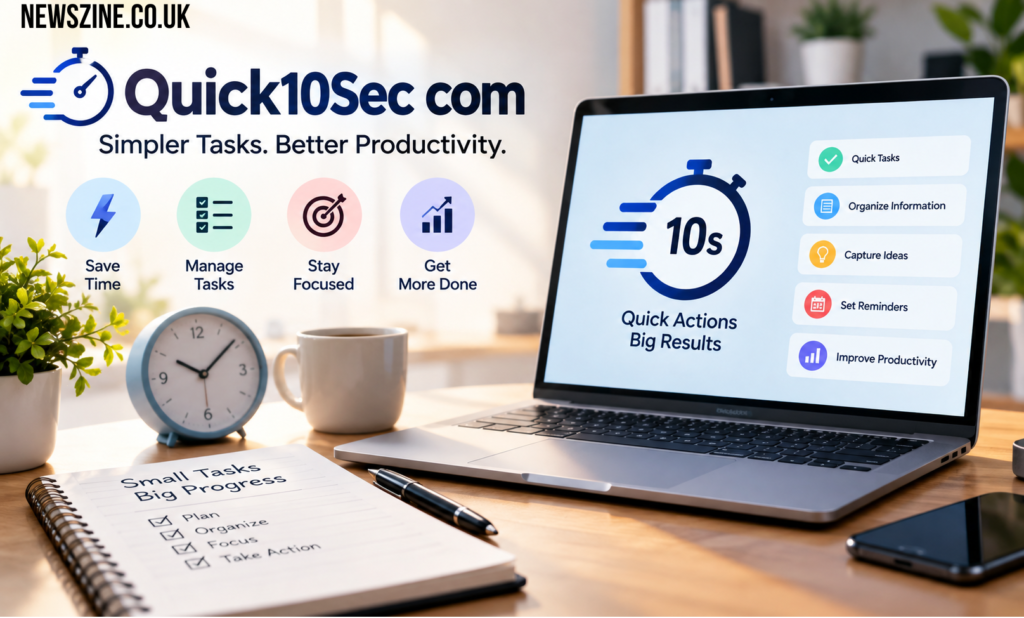
Quick10Sec com
Quick10Sec com is a name that naturally suggests speed, simplicity, and completing small actions without unnecessary delay. The idea fits a wider shift in how people approach productivity online. Instead of treating productivity as a complicated system involving long schedules, detailed planners, and multiple applications, a quick-action approach focuses on what can be handled immediately.
The concept behind quick10sec com can therefore be understood through short digital interactions and practical productivity habits. A person may have dozens of minor tasks during a normal day: checking a detail, saving an idea, organizing information, responding to something simple, or deciding what needs attention next. Individually, these actions are small, but together they can consume a surprising amount of time. A system built around quick actions attempts to reduce that friction.
What Is Quick10Sec com?
Quick10Sec com can be viewed as an online concept centered on fast access to information, brief tasks, and straightforward digital experiences. The name itself communicates an important principle: users often want to reach the information or action they need without moving through several unnecessary stages.
This does not mean every job can or should be completed in ten seconds. Research, writing, financial planning, business decisions, and other serious activities require appropriate time and attention. The more useful interpretation is that small actions should remain small. If something requires only a few moments of attention, the process surrounding it should not make it unnecessarily complicated.
The Idea Behind Productivity Quick10Sec com
The phrase productivity quick10sec com connects short actions with better management of time. Conventional productivity methods often focus on major goals, structured schedules, established habits, and planning for future priorities. Those methods remain useful, but they do not always address the countless tiny decisions that interrupt a working day.
A quick-action model looks at these smaller moments differently. Handling small responsibilities as they arise can prevent a backlog and leave more time and focus for higher-priority work. The objective is not constant activity. It is reducing the amount of mental space occupied by tasks that should be easy to complete.
Why Small Tasks Matter for Productivity
Large projects are easy to recognize because they usually have deadlines, requirements, and measurable outcomes. Small tasks are less noticeable. A person might need to rename a document, record an idea, check a date, update a short note, or organize a piece of information. None of these activities seems significant alone.
Problems develop when dozens of these unfinished actions remain in the background. Unfinished tasks can leave people feeling as though their list of responsibilities never truly ends. A quick productivity method encourages people to identify genuinely minor tasks and complete them efficiently rather than repeatedly thinking about them.
Reducing Unnecessary Steps
One of the most practical lessons associated with the quick10sec com idea is the value of removing unnecessary steps. Digital tools sometimes turn basic activities into complicated processes. Users may need to open several pages, navigate menus, create accounts, dismiss pop-ups, or search through poorly organized information before reaching what they actually need.
Good productivity design works in the opposite direction. It makes common actions easy to locate and understand. When an online resource presents information clearly and limits distractions, users spend less time figuring out the interface and more time completing their intended task.
Speed Is Not the Same as Rushing
Completing work efficiently means using time wisely, while rushing often sacrifices care and accuracy for speed. Productivity does not improve simply because everything is performed faster. Trying to finish complex work too quickly can introduce errors, reduce accuracy, and create additional work later.
The quick-action principle is most appropriate for simple activities with limited consequences. A brief organizational task may be suitable for immediate completion, while reviewing a contract or preparing an important report clearly deserves more attention. Effective productivity depends on knowing which tasks can be shortened and which ones require deeper concentration.
Quick10Sec com and Digital Attention
Attention has become an important part of personal productivity. Every unnecessary notification, open browser tab, repeated check, or distracting interface can interrupt concentration. Even when an interruption lasts only a few seconds, returning to the original task may take longer.
A quick digital system can help by keeping interactions focused. Users should be able to identify what they need, complete the relevant action, and continue with their main work. This approach treats attention as a limited resource rather than assuming people can constantly switch between unrelated activities without consequences.
The Value of a Simple Interface
Simplicity can have a direct effect on how efficiently people use a website or digital tool. A crowded interface forces visitors to make more decisions. They must determine which button matters, where information is located, and whether additional features are relevant to their purpose.
For a platform associated with speed, straightforward navigation becomes particularly important. Clear labels, readable text, logical organization, and obvious functions can make a service feel faster without changing its underlying technology. Sometimes productivity improvements come from better presentation rather than adding more features.
Quick Actions and Daily Work
The quick10sec com productivity idea can be applied to normal working routines even outside a particular website. Workers regularly encounter tiny tasks between larger assignments. Some can be handled immediately, while others should be grouped together for later attention.
For example, recording a short reminder may take only seconds and prevent an idea from being forgotten. Moving a completed file into the correct folder can keep a workspace organized. Updating a brief status after finishing a task can prevent confusion later. These actions are useful because they close small loops without becoming separate projects themselves.
Avoiding the Trap of Constant Micro-Tasks
There is also a downside to focusing too heavily on quick tasks. Completing several small jobs can create a feeling of productivity even when important work remains untouched. Answering minor messages, reorganizing folders, checking statistics, and updating lists may feel satisfying because each activity produces an immediate result.
However, meaningful productivity requires balance. Small tasks should support larger priorities rather than replace them. A useful quick-action system helps clear minor obstacles so users can concentrate on significant work. It should not encourage endless activity simply for the sake of staying busy.
Productivity Through Better Priorities
A person can complete twenty small tasks and still make little progress if none of them matters. For this reason, prioritization remains essential. Before using any productivity method, it helps to distinguish urgent work, important work, routine maintenance, and optional activity.
The quick10sec com approach makes the most sense after priorities are established. Once a person knows what matters, short actions can be used to remove minor barriers around those priorities. This creates a practical relationship between speed and purpose instead of treating speed as the main objective.
Using Short Time Gaps More Effectively
Most people experience small gaps during the day. These may occur while waiting for a meeting, between scheduled activities, or after finishing one task before beginning another. Such periods are often too short for demanding work but long enough for a basic administrative action.
A quick-task approach can make these gaps useful. Someone might review a short reminder, organize a note, confirm a simple detail, or prepare the next task. The purpose is not to eliminate every idle moment. Rest is important as well. The idea is simply to recognize that some minor responsibilities fit naturally into short periods.
Building Better Digital Habits
Productivity depends heavily on repeated behavior. A powerful application cannot compensate for poor habits if a user constantly interrupts work, ignores priorities, or allows small responsibilities to accumulate. Digital tools are most useful when they support an existing routine.
Quick10Sec com can be connected to the broader principle of making useful actions easier to perform. When an activity is simple, people are more likely to repeat it. Saving information in the correct place, recording a task immediately, or clearing a minor administrative item becomes easier when the process involves little friction.
Information Should Be Easy to Understand
Speed is not only about how quickly a page loads or how few buttons a user clicks. Information itself must also be understandable. A page filled with unnecessary explanations can slow visitors down just as much as a complicated menu.
Clear writing supports productivity by allowing readers to identify the main point quickly. Headings should explain what each section covers, instructions should describe actions directly, and important information should not be buried beneath unrelated material. This approach is particularly relevant to platforms whose identity is connected with fast digital interactions.
Mobile Productivity and Short Interactions
Short digital tasks are especially relevant on smartphones. People often use mobile devices while away from their main workspace, which means they may have limited time and attention. A complicated process that feels manageable on a desktop can become frustrating on a smaller screen.
Mobile-friendly productivity therefore depends on reducing unnecessary input. Large navigation elements, readable layouts, short forms, and clearly defined actions can improve usability. If quick10sec com follows a speed-oriented philosophy, mobile simplicity would naturally fit that direction.
Productivity Tools Should Solve a Specific Problem
A common weakness of productivity platforms is attempting to provide too many functions at once. Adding calendars, timers, notes, reminders, dashboards, analytics, collaboration tools, and artificial intelligence may sound useful, but a crowded collection of features can create additional complexity.
A more focused service asks a simpler question: what specific problem does the user need solved? Once that problem is identified, the shortest reliable process can be designed around it. A limited tool that performs one useful task efficiently can sometimes provide more practical value than a large platform filled with rarely used options.
Measuring Whether a Quick System Actually Helps
A productivity method should be judged by results rather than appearance. A fast interface is useful only when it reduces effort or helps people complete meaningful work. Users can evaluate a quick-action system by considering how much time it saves, whether it reduces repeated work, and whether it makes information easier to manage.
Another useful measure is mental effort. If a system requires users to remember complicated procedures, maintain several lists, or repeatedly organize the same information, it may create more work than it removes. The strongest productivity methods tend to become almost invisible because they fit naturally into existing routines.
Privacy and Security Still Matter
Convenience should never completely replace caution. Before entering personal information into an unfamiliar website, users should understand what information is being requested and why. This is particularly important for email addresses, login credentials, financial information, or private documents.
Users should also distinguish between harmless quick utilities and services that request sensitive access. A ten-second action is not worthwhile if it exposes information unnecessarily. Speed, privacy, and security should therefore be considered together when evaluating any online productivity resource.
Who May Find the Quick-Action Approach Useful?
The underlying productivity method can appeal to students, office workers, freelancers, business owners, content creators, and anyone who manages several digital responsibilities. These users may have different goals, but they often share the same problem: small tasks interrupt larger work.
For such users, quick actions can function as supporting tools rather than complete productivity systems. A student might quickly record an assignment reminder, while a freelancer could update a project note after completing a stage of work. The value comes from reducing the effort required to maintain organization.
When a Ten-Second Mindset Does Not Work
Some responsibilities cannot be reduced to quick interactions. Strategic planning, detailed research, technical troubleshooting, creative work, important communication, and major financial decisions require sustained attention. Trying to apply a speed-first mentality to these activities may reduce quality.
A better approach is to use quick methods around deep work rather than inside it. Preparing a document, setting a reminder, opening the correct resources, or recording the next step can be fast. The actual intellectual work should receive whatever time it genuinely requires.
Quick10Sec com as a Productivity Concept
The strongest idea associated with quick10sec com is not simply doing everything quickly. It is keeping simple things simple. Many digital routines become inefficient because users tolerate unnecessary steps that gradually become normal.
Removing those steps can create meaningful improvements. A shorter process, clearer interface, better-organized information, or immediate handling of a genuinely minor task may save only seconds at first. Repeated across weeks or months, however, those small improvements can reduce friction and make daily workflows easier to manage.
Conclusion
Quick10Sec com represents an approach to digital productivity built around short actions, straightforward processes, and reduced friction. Its underlying lesson is useful even beyond a single website: not every responsibility needs a complicated system. Small tasks should often be handled through simple methods that allow people to return quickly to their main priorities.
At the same time, productivity should not be measured by speed alone. Important work still requires concentration, judgment, and sufficient time. The most practical use of the productivity quick10sec com idea is therefore selective—make routine actions faster, remove unnecessary digital steps, and preserve attention for the work that actually deserves it.