Reading Research Papers with iBoomto Without Skipping the Evidence
iBoomto AI PDF summarizer
Reading research papers can be challenging, especially when they’re full of long explanations, technical jargon, tables, and figures with all sorts of statistics. When someone writes a summary to capture the key points, they may omit many details.
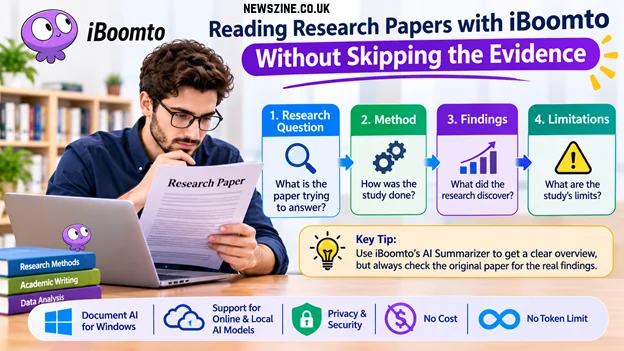
Split the reading process into 4 parts (research question, method, findings, limitations), and that’s a better approach. It enables the reader to get a much clearer understanding of what the study is about, how it was conducted, what the researchers actually found, and what the implications of those findings are.
AI tools can be used to help with this, and iBoomto AI PDF summarizer offers a very practical approach to document-related tasks.
Introducing iBoomto: Document AI for Windows
iBoomto is a Document AI solution for Windows that can be used to automate a lot of the day-to-day document processing. It works with both online and local AI models, so you can use it with your own research papers, reports, and the like.
The AI PDF summariser enables you to get a general overview of a long document prior to looking at any particular section. Privacy and security are of course key considerations when you’re dealing with your own research or unpublished work.
Another plus is that it’s free and there’s no token limit. That makes it very accessible to students, researchers, and knowledge workers who are going to be looking at long documents quite regularly.
Step 1: Identify the Research Question
To get a feel for the paper’s intent to explore. Examine the manuscript’s title, abstract, opening section, and clearly defined research objectives.
Ask yourself:
– What specific issue are the researchers seeking to address?
– What problem are they solving?
– Why does this research matter?
State the central research question in one or two sentences. That will give you a clear direction rather than starting off with the technicalities.
Step 2: Understand the Research Method
The method describes how the researchers conducted their investigation. It could be an experiment, a survey, interviews, observations, or a statistical analysis depending on the topic.
Focus on the participants, the sample size, the materials, the procedures, and the data collection processes.
If it’s a paper looking at the outcomes of student learning, for example, look at the methods they employed in their learning (surveys, classroom experiments, exam scores, etc.). Once you know the method, you can then appreciate how the findings have been achieved.
Step 3: Examine the Findings with an AI Summarizer
Note that in very long research papers you can have several pages of results/explanations. With iBoomto’s AI PDF Summariser, you can get a quick summary of the document and highlight the key points.
Send the PDF via the workflow that was provided and note the results that were summarised.
Remember that an explanation generated by an AI is an interpretation of the paper, not the actual research evidence in the paper. Always go back to the results, the tables, the figures, and the statistical stuff to check the significance of any claims.
Be careful that the summary is an accurate representation of what the researchers have found.
Step 4: Never Ignore the Limitations
All the research studies are going to be limited in some way or another. That could be a small number of participants, a limited research context, measurement issues, or limited generalisability to other groups.
Carefully consider the limitations section and ask whether those limitations have any bearing on the conclusions.
Results of a study might be very positive, but they may not be applicable in all circumstances. It’s important to be aware of these limitations so as not to go on and assume that the assumptions underlying the research findings are in fact true.
Keep Your Research Notes Organized
Once you’ve had a look at the paper, just write a short note with the following headings: Research Question, Method, Findings and Limitations.
Make notes of the key points, page numbers, stats and citations. Make sure you have a copy of the original PDF with your notes in it so that you can go back to the source if you need to.
This is a method which enables you to work on assignments, literature searches, academic projects and independent research.
Final Thoughts
Effective reading of the papers themselves is not enough to get to grips with the abstracts and/or summaries. You need to analyse the research question, the method, the results and the limitations.
To help with the initial document review process, we’ve got iBoomto Document AI, which works on the Windows platform. It has both online and local AI model support, a strong focus on privacy and security, is completely free, and has no token limit.
While it can provide you with summaries, the best research practice is to use AI to find the information more efficiently and then go back to the source before you come to any conclusion.