
Claude API Explained: API Keys, Features, Security and Developer Uses
Claude API
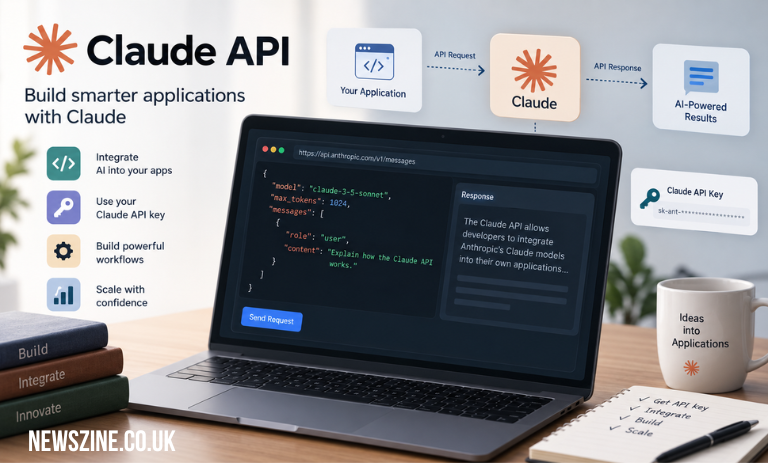
Claude API is a developer service from Anthropic that allows software applications to communicate directly with Claude AI models. Instead of opening a Claude interface and entering prompts manually, developers can send information from their own websites, mobile apps, internal systems or software tools and receive AI-generated responses programmatically.
This makes the Claude API useful for businesses and developers that want AI to operate as part of an existing product. A company might connect it to customer support software, a document-processing system, an internal knowledge tool or a coding platform. The application sends a request, Claude processes the instructions and supplied information, and the generated result is returned to the application.
Access normally begins with a Claude Console account and authentication credentials such as a Claude API key. Anthropic currently provides its main API as a RESTful service through api.anthropic.com, with the Messages API serving as the primary route for direct model conversations.
What Is the Claude API?
The Claude API is essentially a connection between a developer’s software and Anthropic’s Claude models. An API, or application programming interface, defines how two software systems can exchange requests and responses.
For example, imagine a company has an online form containing hundreds of customer questions. Instead of asking employees to read every question manually, the company’s software could send each message to Claude together with instructions about how it should be classified. The response could then be stored in the company’s database or displayed to a support employee.
This differs from simply using Claude through a normal chat interface. With an API, developers determine when requests are sent, what information is included, how answers are presented and what happens after a response is returned.
Anthropic’s Messages API currently uses the /v1/messages endpoint. It accepts structured messages and can generate responses from text and other supported content types. It can also be used for a single request or as the foundation of a multi-turn conversation managed by the developer’s application.
What Is a Claude API Key?
A Claude API key is an authentication credential used to identify and authorise requests made to Anthropic’s API.
It can be compared with a password used specifically by an application. When software sends an API request, the credential tells Anthropic which account or organisation is responsible for the request. This is important for authentication, usage measurement, billing and access control.
Developers should therefore treat an API key as confidential information. It should not be placed in publicly accessible source code, screenshots, browser-side JavaScript or public repositories.
One common approach is to store the credential in an environment variable on the server. The application reads it when required without exposing the value to users.
Anthropic’s current API documentation states that direct API access requires a Claude Console account and either an API key or an appropriate Workload Identity Federation configuration.
How Claude API Requests Work
A basic Claude API interaction starts inside the developer’s application. The application prepares a request containing information such as the selected model, the user’s message and the maximum amount of output that should be generated.
That request is sent to Anthropic’s API. Claude processes the supplied context and instructions before creating a response. The application receives structured data containing the model’s output and can then decide what to do with it.
A chatbot may immediately display the generated answer. A document service might save it. An analytics system could extract a particular field and place it into a database.
The Messages API is designed around structured conversational turns. Developers can supply user and assistant messages to represent an ongoing exchange. Because developers control this conversation history, they can decide how much earlier context should be included with later requests.
This flexibility is one reason APIs are widely used for building AI products. Claude provides the language-processing capability, while the surrounding application determines the workflow.
Using Claude API in an Application
A developer first needs access to Anthropic’s platform and suitable authentication credentials. The next step is normally installing an official software development kit or communicating with the REST API directly.
Anthropic provides API interfaces that can be used from common programming environments. Python and TypeScript are frequent choices, although applications are not limited to those languages because HTTP requests can be made from many development platforms.
A basic application sends a user message and specifies which Claude model should process it. It also provides a max_tokens value controlling the maximum generated output length. Anthropic notes that this value sets an upper limit rather than guaranteeing that the model will always use the full allowance.
After receiving the result, developers can extract the returned content and pass it to another part of their software.
The important point is that the Claude API does not determine the entire product. Developers remain responsible for the user interface, databases, permissions, validation, business rules and other components surrounding the AI request.
Claude API and Multi-Turn Conversations
A single question-and-answer request is straightforward, but many applications require an ongoing conversation.
Suppose a customer first asks about a product and then says, “What about the cheaper version?” The second question only makes sense when the system understands the earlier discussion.
An application can preserve previous conversational messages and include the relevant history when making another request. Claude can then interpret the latest message in relation to that context.
Anthropic describes the Messages API as suitable for both single requests and stateless multi-turn conversations. In practice, this means the application commonly takes responsibility for maintaining the conversation state that it wants to send back to the model.
Developers therefore need to think carefully about how much conversation history is necessary. Sending unnecessary information can increase token use, while removing too much context may make responses less useful.
Common Uses of Claude API
One major use is customer assistance. Businesses can integrate Claude into support software to help answer common questions, summarise customer problems or draft replies for employees. Human review can still be used when decisions require judgement or involve sensitive issues.
Document work is another common area. Applications can use language models to summarise lengthy material, identify important points, compare information or convert unstructured text into a more useful format.
Developers also use Claude for programming-related workflows. An application might ask a model to explain code, generate implementation suggestions, examine errors or assist with internal software documentation.
Content systems can use API access for drafting descriptions, restructuring text or generating personalised material at scale. However, businesses still need their own editorial and quality-control processes because generated text should not automatically be treated as verified fact.
Another area is information extraction. A company receiving thousands of messages, reports or forms can ask Claude to identify categories, names, topics or other useful information before passing the results into another system.
The API can therefore act as one component inside a larger workflow rather than simply functioning as a standalone chatbot.
Working With Different Types of Input
Modern Claude API interactions are not limited to a plain sentence entered by a user.
Anthropic’s Messages API supports structured message content, and its current API reference includes supported image formats such as JPEG, PNG, GIF and WebP. PDF input is also represented in the API’s message types.
This broadens the types of applications developers can build. A system may analyse a supplied image together with a written question, for example, or process documents as part of a review workflow.
Developers should still check the requirements of the particular Claude model and API feature being used. Model capabilities and platform functionality can change, and older model versions can eventually be retired.
Anthropic maintains a model deprecation policy and recommends moving applications away from models before their retirement dates. Several older Claude models were retired during 2026, showing why production applications should avoid assuming that a particular model identifier will remain available indefinitely.
Prompt Design Matters
Access to a capable model does not automatically produce reliable output. The quality of the instructions sent to Claude remains important.
A vague prompt such as “analyse this” leaves many decisions open to interpretation. A stronger request explains what should be analysed, why it matters, what information should be excluded and how the result should be formatted.
Anthropic’s current prompting guidance recommends clear and direct instructions. It also suggests providing relevant context and using examples when developers need consistent formatting or behaviour.
For applications handling complicated information, developers may separate instructions, context and source material into clearly structured sections. This makes the job of the model more explicit.
Testing is equally important. A prompt that performs well on one example may behave differently when users provide unusual, incomplete or conflicting information. Production developers normally need a wider evaluation set rather than testing only a few convenient inputs.
Claude API Rate Limits
API services cannot accept unlimited traffic from every account, so Anthropic applies usage controls.
Claude API rate limits can involve requests per minute, input tokens per minute and output tokens per minute. The exact allowances depend on the model and the organisation’s usage tier. Anthropic also uses spending limits that restrict how much API usage an organisation can incur within a period.
This becomes important when an application grows.
A small internal tool making a few requests each hour may rarely encounter these restrictions. A public service processing thousands of requests can reach them much more easily.
When a rate limit is exceeded, the API may return an HTTP 429 response. Anthropic provides rate-limit information and a retry-after header that applications can use to determine when another attempt should be made.
A reliable integration should therefore plan for temporary failures instead of assuming every request will succeed immediately.
Token Usage and Cost Control
API usage is closely connected with tokens. Tokens are pieces of text processed by a language model, rather than being exactly equivalent to words.
Long prompts generally consume more input tokens, while lengthy responses require more output tokens. Applications that repeatedly submit large documents or extensive conversation histories can therefore use considerably more resources than applications processing short messages.
Anthropic provides a token-counting endpoint alongside its Messages API, allowing developers to estimate the number of input tokens associated with a request.
Cost control should consequently be designed into an application from the beginning. Developers can reduce unnecessary context, select a model suited to the task and limit output where very long responses provide little benefit.
Usage monitoring is also important for detecting unexpected traffic or poorly designed workflows before they create larger costs.
Message Batches for Larger Workloads
Some AI tasks can be completed effectively without needing an instant response.
A business may have thousands of documents waiting to be classified overnight, for example. Processing these one by one through an interactive workflow may not be the best approach.
Anthropic offers a Message Batches API for larger groups of Messages requests. Its current documentation states that batch processing can reduce costs by 50 percent compared with normal Messages API processing, although batches operate differently from immediate interactive requests.
This type of processing can be useful for back-office operations, research preparation, bulk classification, content analysis and other jobs where receiving every answer within seconds is unnecessary.
Interactive requests and batch processing therefore serve different purposes. Choosing between them depends on how quickly results are required and how the surrounding workflow operates.
Protecting a Claude API Key
Security mistakes involving API credentials can be expensive.
A key should never be hard-coded into a public website where visitors can inspect it. Developers should also avoid publishing it in GitHub repositories, tutorials, screenshots or configuration files that are publicly available.
Server-side environment variables and managed secret-storage systems are safer approaches. Access should also be limited to services and employees that genuinely need the credential.
If a credential is accidentally exposed, continuing to use the same key increases the risk of unauthorised activity. The appropriate response is generally to revoke or rotate the compromised credential and review usage for anything unexpected.
Development and production systems can also be separated. This reduces the chance that experimental software receives unnecessary access to a production environment.
Protecting the API key is not simply an Anthropic-specific concern. It is a standard part of securing any application that communicates with a paid external API.
Handling Errors and Failed Requests
AI integration involves more than sending a request and displaying the answer.
Networks can fail. Inputs may be invalid. An account can reach its usage limits. A selected model may become unavailable, and an API service can occasionally return temporary errors.
Developers should therefore build error handling around their Claude integration.
Temporary failures may justify a controlled retry. Invalid requests usually need to be corrected rather than repeatedly submitted. Rate-limited requests should respect the server’s retry guidance instead of immediately sending large numbers of additional attempts.
Logging can also help identify recurring failures, but logs should be designed carefully so that sensitive prompts, credentials or user information are not exposed unnecessarily.
The difference between a demonstration and a production application often becomes visible here. A demonstration only needs to work under ideal conditions. A real service must behave sensibly when conditions are not ideal.
Claude API for Business Applications
For companies, the main value of an API is control over integration.
A business does not need employees to copy information manually into an AI chat interface every time they want assistance. Instead, AI functionality can be inserted directly into the company’s existing workflow.
An insurance system could summarise submitted documents before an employee reviews them. A software company could add an assistant inside its developer product. A research organisation could process large quantities of written material, while an ecommerce business could help categorise product information.
The API itself does not decide whether these implementations are appropriate. Businesses remain responsible for privacy requirements, human oversight, security, legal obligations and the consequences of using generated results.
For higher-risk decisions, AI output is generally more suitable as supporting information than as an unquestioned final authority.
Claude API Versus the Claude Chat Interface
The Claude chat interface is designed mainly for direct interaction between a person and Claude. The API is designed for software integration.
A user who wants help writing one document may simply use the conversational interface. A developer who wants thousands of customers to access AI features inside an existing application generally needs programmatic access.
The API gives developers greater control over prompts, model selection, application behaviour, stored context and downstream processing. That additional control also creates additional responsibility.
Developers must manage credentials, code, data handling, monitoring, error recovery and spending themselves.
Neither approach is automatically better. They address different requirements.
Is Claude API Suitable for Every Project?
Claude API can be useful when a project genuinely benefits from language understanding or generation, but adding an AI model to every feature does not necessarily improve a product.
Traditional software remains more appropriate for tasks that follow fixed, predictable rules. There is little reason to ask a language model to calculate something that a basic deterministic function can handle more reliably and cheaply.
Claude becomes more useful when information is unstructured, instructions vary, language understanding matters or the desired output cannot easily be produced with a simple set of fixed rules.
Successful applications often combine both approaches. Conventional software handles authentication, calculations, databases and strict business logic, while Claude deals with tasks where flexible language processing adds value.
Final Thoughts
Claude API gives developers a practical way to place Anthropic’s AI models inside websites, business systems, developer tools and other software products. Rather than requiring users to communicate with Claude through a separate chat interface, applications can send structured requests and use the returned results inside their own workflows.
A Claude API key plays an important role in this process because it authenticates access and connects usage with the appropriate account or organisation. Protecting that credential should be treated as a basic security requirement.
The technical connection itself can be relatively simple, but building a dependable AI product requires more work. Prompt design, cost monitoring, rate-limit handling, security, testing and model updates all need attention.
Claude API is therefore best understood not as a complete application, but as an AI capability that developers can combine with their own software. Its usefulness depends on how carefully that capability is integrated into the wider system.