Mashable Connections Hint Today: Clues, Categories and Puzzle-Solving Guide
Mashable Connections Hint Today
Finding the right amount of help with NYT Connections can be difficult. Some players only need a small clue to spot a category, while others want the category names but would still prefer to work out the four matching words themselves. A useful Mashable Connections hint today style guide should therefore give assistance in stages instead of placing the complete solution at the top of the page.
Puzzle #1,143 mixes words about taking charge, several kinds of apples, well-known footwear labels, and a final group built around hidden palindrome names. Two of the groups are fairly easy to recognise once the right words catch your attention. The other two require more care because several terms appear capable of belonging to more than one possible category.
The best way to approach this board is not to rush into the first connection you notice. Connections is built around words with several meanings, and the puzzle often encourages players to create an almost-correct group. Looking for exact four-word relationships before submitting a guess can save valuable mistakes.
How the Connections Puzzle Works
NYT Connections presents a grid containing 16 words. The goal is to divide those words into four groups, with exactly four words in each group. Every group is linked by one specific idea.
The difficulty comes from overlap. A word may seem connected to several other words even though only one combination is intended. For example, a word associated with leadership could also be a noun, a title, a place, or part of another expression.
The game traditionally labels its categories by colour. Yellow is usually considered the most accessible group, followed by green and blue. Purple often involves the most unusual connection, such as word construction, hidden terms, missing letters, phrases, or another form of language play.
That difficulty order is useful, but it is not a rule for how every player will experience a puzzle. Somebody familiar with fashion brands may solve a blue brand category before recognising a yellow group of ordinary verbs.
A First Look at Puzzle #1,143
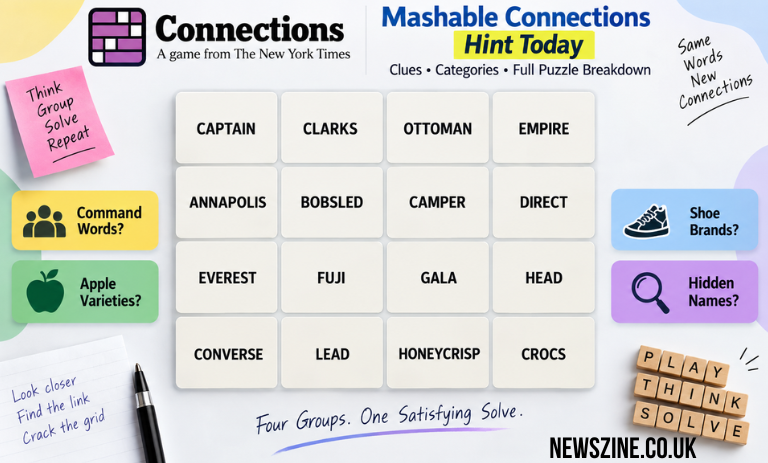
The 16 entries supplied for this board are:
CAPTAIN, CLARKS, OTTOMAN, EMPIRE, ANNAPOLIS, BOBSLED, CAMPER, DIRECT, EVEREST, FUJI, GALA, HEAD, CONVERSE, LEAD, HONEYCRISP, and CROCS.
At first glance, some words immediately begin to form possible clusters. FUJI, GALA, and HONEYCRISP are strongly associated with apples. CLARKS, CONVERSE, and CROCS are recognisable footwear names.
That creates two useful starting points, but both possible groups are missing a fourth word.
Connections frequently works this way. Three entries may appear obvious while the fourth is disguised among words that seem unrelated. The safest move is to keep the three likely members in mind while examining the remainder rather than forcing a fourth choice too quickly.
The same board also contains CAPTAIN, DIRECT, HEAD, and LEAD. Each can describe the act of guiding, managing, or being in charge of something.
The remaining words look much less connected by meaning. That is usually a strong signal that the final category may depend on spelling rather than definitions.
Gentle Mashable Connections Hint Today
If you want help without seeing the category names immediately, think about these four broad areas:
One group is about being in control.
One group belongs in the produce section of a supermarket.
One group can be found in the footwear market.
One group becomes clear when you examine how each word begins.
These clues should be enough for many players to continue independently.
Pay particular attention to the difference between a word’s normal meaning and its construction. Connections frequently leaves the most unusual set until players stop asking, “What do these words mean?” and start asking, “What do these words contain?”
Stronger Hint for the Fruit Group
Three words on the board provide a particularly strong clue:
FUJI
GALA
HONEYCRISP
They are all well-known apple varieties.
The challenge is locating number four.
Rather than looking for something that sounds like a fruit, think of another word on the board that can also be the name of an apple cultivar. One entry that might initially suggest politics, history, or geography belongs here instead.
The fourth member is EMPIRE.
That completes a highly specific set and makes it a good candidate to solve early.
Why EMPIRE Can Be Easy to Miss
EMPIRE illustrates one of the main tricks used in Connections. Most people first interpret the word through its everyday meaning: a large political territory or powerful organisation.
In this puzzle, however, its familiar definition is irrelevant.
Empire is also an apple variety.
This kind of double use is exactly why Connections rewards players who question their first interpretation of a word. When three members of a group are certain and the fourth seems absent, it is often worth checking whether another word has a secondary meaning that fits perfectly.
The completed apple group is:
EMPIRE, FUJI, GALA, HONEYCRISP
Hint for the Footwear Category
Another promising trio appears in:
CLARKS
CONVERSE
CROCS
All three names are associated with footwear.
The fourth entry follows the same pattern but may be less immediately obvious to players who do not regularly follow shoe brands.
Look for another word beginning with the same letter.
That word is CAMPER.
Camper is a footwear company, so the four names form a complete group.
The shared opening letter also makes the category more precise than simply “shoe brands.”
The set is:
CAMPER, CLARKS, CONVERSE, CROCS
Why Specific Groups Are Safer
Connections often contains several loose associations. A player might be able to argue that five or six words have something in common, but the intended categories normally have a clearer rule.
For example, identifying four actual footwear brands is more reliable than grouping four words that merely relate to travel or clothing.
This leads to a useful solving principle: specific relationships should usually be trusted before broad relationships.
Four recognised brands, four exact varieties, four titles, or four words sharing the same linguistic structure are generally stronger than a category such as “things connected with movement.”
When a possible category feels vague, keep searching before using a mistake.
Hint for the Leadership Group
After removing the apple and footwear groups, several remaining words become easier to evaluate.
Consider:
CAPTAIN
DIRECT
HEAD
LEAD
All four can be used as verbs.
A person can captain a team, direct a project, head a department, or lead an organisation. Although the words are not identical in every context, each can express taking charge of people or an activity.
This group can initially cause difficulty because some of the entries have very common noun meanings.
A captain can be a person.
A head can refer to part of the body.
A lead can refer to an advantage, a clue, or a material depending on pronunciation and context.
A direct interpretation might make players think about instructions or routes.
The puzzle asks players to move beyond those first meanings and recognise their shared use as verbs involving control or leadership.
The group is:
CAPTAIN, DIRECT, HEAD, LEAD
The Hardest Category Requires a Different Approach
Once three groups have been identified, the remaining four entries are:
ANNAPOLIS
BOBSLED
EVEREST
OTTOMAN
Trying to connect them through their ordinary definitions creates confusion.
Annapolis is associated with a place name. A bobsled is sporting equipment. Everest is a mountain name. An ottoman can refer to furniture or history.
There is no useful shared subject connecting all four.
That is the clue.
When four leftover Connections words seem completely unrelated, inspect their letters.
Look specifically at their beginnings.
ANNAPOLIS starts with ANNA.
BOBSLED starts with BOB.
EVEREST starts with EVE.
OTTOMAN starts with OTTO.
ANNA, BOB, EVE, and OTTO are all names. More importantly, each reads the same forwards and backwards.
They are palindromes.
That gives the final category its rule: words beginning with palindromic names.
Understanding the Palindrome Trick
A palindrome is a word, name, number, or sequence that remains the same when its order is reversed.
ANNA backwards is ANNA.
BOB backwards is BOB.
EVE backwards is EVE.
OTTO backwards is OTTO.
The complete words do not need to be palindromes. Only their opening sections matter.
That distinction explains why the category may remain hidden for so long. Players naturally examine ANNAPOLIS, BOBSLED, EVEREST, and OTTOMAN as complete words. Nothing obvious connects them.
The pattern only appears after breaking each word into parts.
This is typical of harder purple Connections categories. The answer may depend less on vocabulary knowledge and more on noticing how words are constructed.
Full Connections Categories
If you have reached the point where you want the complete groups, the puzzle can be arranged as follows:
| Category | Words | Shared Link |
|---|---|---|
| Command or lead | CAPTAIN, DIRECT, HEAD, LEAD | Verbs meaning to take charge |
| Apple varieties | EMPIRE, FUJI, GALA, HONEYCRISP | Types of apples |
| Shoe brands beginning with C | CAMPER, CLARKS, CONVERSE, CROCS | Footwear brands |
| Words starting with palindromic names | ANNAPOLIS, BOBSLED, EVEREST, OTTOMAN | ANNA, BOB, EVE and OTTO |
The board becomes much easier to understand once the first two specific groups are removed.
Which Group Should You Solve First?
The apple category is probably one of the safest starting points because FUJI, GALA, and HONEYCRISP provide strong evidence.
Before submitting it, however, you still need to confirm the fourth member. EMPIRE may not immediately look like an apple name, which is where careful checking becomes important.
The footwear group provides another strong option. Once CLARKS, CONVERSE, and CROCS are noticed, checking the remaining C words can reveal CAMPER.
Solving either category reduces the grid from 16 words to 12. Solving both cuts it to eight.
At that stage, CAPTAIN, DIRECT, HEAD, and LEAD stand out much more clearly, leaving the four wordplay entries automatically.
This process shows why Connections often becomes easier after one confident group is removed. Every solved category reduces the number of possible false relationships.
Do Not Submit Every Possible Group Immediately
One of the most common Connections mistakes is pressing submit as soon as four vaguely related words appear.
A better habit is to test the group mentally.
Ask whether all four entries satisfy exactly the same rule.
Then ask whether any of them seems to belong even more strongly with another set.
Finally, search for a fifth word that could fit your proposed category. If five words seem equally suitable, you probably have not identified the intended distinction yet.
For this board, a category such as “things associated with authority” could become too broad. CAPTAIN, HEAD, and LEAD might fit, but other interpretations could create distractions.
The stronger formulation is that CAPTAIN, DIRECT, HEAD, and LEAD can all function as verbs meaning to command or guide.
Precision matters.
Look at Grammar When Meaning Creates Confusion
A useful Connections technique is changing the grammatical role of a word.
Do not assume a noun must remain a noun.
CAPTAIN is commonly recognised as a noun, but it can also be a verb: “She captained the team.”
HEAD can be a noun or verb: “He heads the department.”
LEAD has several meanings, but as a verb it clearly fits the group.
DIRECT can similarly describe managing or controlling an activity.
Changing the grammatical lens can reveal groups that remain hidden when every word is interpreted in its most familiar form.
Use the Remaining Words as Evidence
Another strong strategy is to test what happens to the board after removing a proposed group.
Suppose you mentally separate EMPIRE, FUJI, GALA, and HONEYCRISP.
Now examine the remaining 12 words.
If another clean group suddenly becomes easier to see, that strengthens your first theory.
Then mentally remove CAMPER, CLARKS, CONVERSE, and CROCS.
Only eight remain.
CAPTAIN, DIRECT, HEAD, and LEAD now share an obvious functional relationship.
The remaining four practically demand a spelling investigation.
This method is more reliable than judging groups independently because Connections is ultimately a complete partition problem: every word must belong somewhere, and no word can appear in two final groups.
How to Recognise a Wordplay Category
Many players find semantic categories easier than language-based groups. That makes recognising the signs of wordplay especially useful.
A spelling category becomes more likely when the remaining words:
seem unrelated in meaning,
include words from completely different subjects,
contain unusual repeated letters or prefixes,
can be divided into smaller recognisable pieces,
or share something visually that is easier to notice when written than spoken.
ANNAPOLIS, BOBSLED, EVEREST, and OTTOMAN satisfy the first clue immediately. Their meanings lead in four different directions.
Once definitions fail, spelling becomes the logical next place to investigate.
Why Daily Connections Hints Should Be Gradual
Players searching for NYT Connections Mashable today style help are not always looking for the same thing.
One person may want only a tiny push. Another may have already solved three categories and need help with purple. A third may simply want the complete answer after finishing the puzzle.
For that reason, the most useful hint format moves from least revealing to most revealing.
A sensible order is:
first offer broad themes,
then reveal stronger category clues,
then explain difficult individual entries,
and only after that provide complete groups.
This keeps the puzzle enjoyable for players who still want to do most of the solving themselves.
A Better Method for Future Connections Boards
The strategy used on this puzzle can also help with future boards.
Start by reading every word once without submitting anything. Identify unusually specific clusters, especially proper names, brands, foods, titles, technical terms, or recognisable sets.
Next, check whether any word has a second meaning. Connections relies heavily on ordinary words that can function differently depending on context.
After that, inspect grammar. A word that appears to be a noun may need to be treated as a verb or adjective.
Then examine spelling. Look at beginnings, endings, hidden words, repeated letter structures, abbreviations, sounds, and familiar words embedded inside longer ones.
Finally, choose the group supported by the narrowest rule.
The objective is not simply to find four related words. It is to identify the exact relationship intended by the puzzle maker.
What Makes This Board Interesting?
Puzzle #1,143 demonstrates several different kinds of Connections logic in a single grid.
The apple category depends mostly on general knowledge.
The footwear category requires recognising brands.
The leadership group tests alternate grammatical uses.
The final category abandons meaning almost completely and relies on letter patterns.
That variety is what makes Connections challenging even when individual words appear simple. The puzzle does not usually demand obscure definitions for all 16 entries. Instead, it asks players to decide which interpretation matters in each case.
A familiar word can therefore become difficult simply because the obvious meaning is the wrong one.
Final Thoughts
A useful Mashable Connections hint today guide should help players see the structure of the puzzle without removing the satisfaction of solving it. For this board, the strongest route is to begin with the highly specific apple and footwear categories, then use the reduced grid to identify the leadership verbs.
The final four words require a different mindset. ANNAPOLIS, BOBSLED, EVEREST, and OTTOMAN are not linked by what they describe. Their connection appears at the start of each word, where ANNA, BOB, EVE, and OTTO form four palindromic personal names.
The larger lesson is useful beyond one puzzle. When Connections seems stuck, do not keep searching only for related meanings. Change how you look at the grid. Check secondary definitions, grammatical roles, brands, names, prefixes, hidden words, and letter patterns. Very often, the solution appears only after the obvious interpretation is set aside.